Kids Cursive Copybook PDF Maker
Large rows, your own words, a printable PDF in one click.
Build a printable cursive copybook page for children in seconds. Type the words you want practised, keep the large 18 mm rows for small hands, and download a US Letter or A4 PDF with a model row followed by light tracing rows. Print as many pages as you need for class or homeschool.
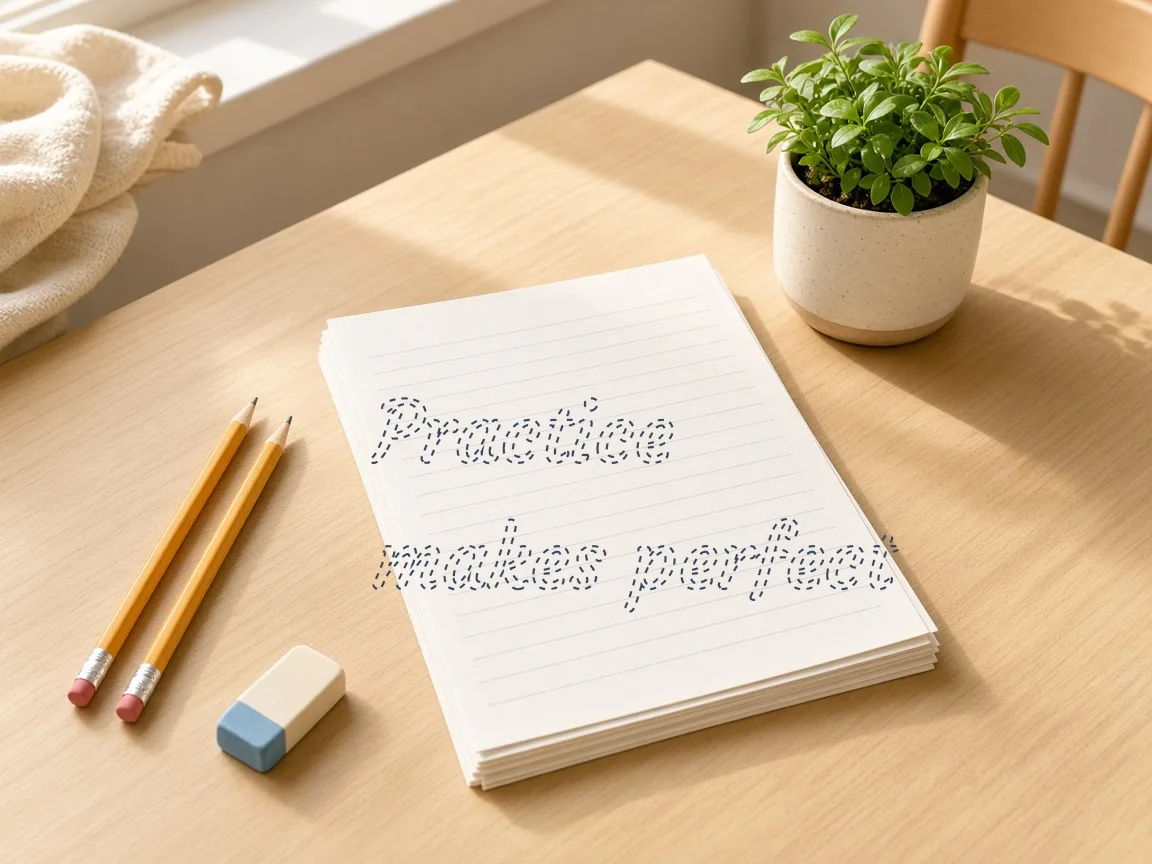
Printable Cursive Worksheet (PDF)
Four-line handwriting rows: ascender line, dashed midline, baseline and descender line. Your text is printed as a model row with light gray tracing rows.
Type some text to begin.
Quick answer
A kids cursive copybook PDF is a printable practice page with wide four-line rows, a model line of cursive and faint dashed letters to trace. This free maker lets you type your own words, choose large rows for young children, and download US Letter or A4 PDFs without signing up.
Key facts
- Price: free for classrooms and families
- Rows: large 18 mm (kids), medium 12 mm or small 9 mm
- Paper: US Letter or A4, portrait or landscape
- Layouts: model row plus tracing rows, or model row plus blank practice rows
- Extras: name and date line, editable worksheet title
How it works
Type the practice words
Letters, a name, spelling words or a short sentence.
Pick large rows
Choose Large · Kids (18 mm) and the paper size your printer uses.
Download and print
Save the PDF and print at 100% scale for accurate line spacing.
Why large four-line rows help young writers
Each row has an ascender line, a dashed midline, a baseline and a descender line. Children use those guides to learn that letters such as a and c sit between the baseline and midline, while l and b climb to the top line and g and y drop below. Larger rows reduce the fine-motor load, so kids can focus on letter shape and the joining stroke instead of squeezing into narrow lines.
As control improves, move from 18 mm to 12 mm rows. Adult practice usually works best at 9 mm.
A simple weekly copybook routine
Day one: trace the model row slowly, saying each stroke aloud (up, over, down). Day two: trace and then write one row from memory. Day three: practise the same letters joined inside short words. Day four: write the child's name and a family word. Day five: copy a short sentence on a blank-row page. Changing only one thing each day keeps practice calm and measurable.
Keep finished pages in a folder. Comparing Monday with Friday is a strong motivator for most children.
Choosing the right cursive font for kids
Courgette is the default because its letters are rounded, upright enough to read and clearly joined. Dancing Script and Playball are good alternatives for a more classic school look. Avoid very decorative wedding scripts for beginners: their extra loops are lovely to look at but hard to imitate. If your school teaches a specific style, choose the closest match and tell the child that small differences are fine.
Frequently asked questions
What age should children start a cursive copybook?
Many children start between ages 7 and 9, once print letters are steady. Earlier practice can focus on the pre-writing tracing lines worksheet.
Can I put my child's name on every row?
Yes. Type the name as the practice text and choose the model row plus tracing rows layout.
Is the PDF really free to print for a class?
Yes. You can print and copy the pages for classroom or homeschool use without sign-up or payment.
Why does my printout look smaller than expected?
Print at 100% or actual size. Fit-to-page settings shrink the rows and change the line spacing.
Print today's copybook page
Free, no sign-up, and your words stay on your device.
Make a copybook page →